



Plan Your Christmas Budget in October: A Simple 3-Envelope Method

Christmas costs land all at once if you don't plan for them: gifts, food, hosting, travel, all inside a few weeks in December. Starting the budget in October instead gives you more pay periods to spread the cost across, so you're setting aside small amounts now instead of finding a big one all at once later. Here's a simple way to do it with three envelopes.
Why October
December is the worst month to start a Christmas budget, because it's also the month you have to spend the money. If you wait until December to figure out what you're doing, you're paying for gifts, food and travel out of whatever is left in your account that month, on top of your normal bills, rent, and anything else already due.
October gives you a head start. If you're paid every two weeks, you likely have four to six paychecks between now and Christmas. If you're paid monthly, that's two or three. Either way, splitting the total across those pay periods turns one large expense into several small ones, and each one is easier to absorb than the full amount at once. A little set aside from each paycheck between now and December adds up to the full amount without any single month feeling tight.

Set the total first
Before you split anything, decide the number. Don't guess. Look at what you actually spent last December, gifts, food, travel, if you have the bank or card statements. That's your starting point, not what you wish you'd spent.
Pick a total you can afford this year, based on your income now, not last year's total by default. Write it at the top of a page. This is the number the rest of the plan works from.
Split it into three envelopes
Once you have a total, break it into three parts. You don't need exact percentages, just a rough split that matches how your Christmas actually looks:
- Gifts. Everyone you're buying for, plus the paper, cards and shipping. This is usually the biggest envelope for most households.
- Food and hosting. Your own gatherings, dishes to bring to someone else's, and the extra groceries the season brings even if you're not hosting.
- Travel and extras. Gas, flights, a hotel if you're visiting family, plus the smaller things that add up: a holiday outfit, decorations, postage.
If you host most years, food and hosting takes a bigger share. If you travel to family instead, that envelope grows and hosting shrinks. There's no fixed rule, the split should match what your December actually looks like.
You can use real envelopes with cash in them, or three lines in a budget planner. For a printable way to plan this, see our holiday budget tracker printable on Etsy. What matters is that each category has its own limit, so overspending on gifts doesn't quietly eat into your travel money without you noticing.

Track as you go
A budget only works if you check it. Once a week, write down what you've spent in each envelope and subtract it from that envelope's limit. This takes a few minutes and tells you early if one category is running ahead, while there's still time to adjust, instead of finding out in January when the credit card statement arrives.
Keep the gift list next to the tracker, not separate from it. Write down who you're buying for, an idea, and the price as you decide it, so the running total updates as you shop instead of adding it all up in a panic later. If you buy something online during a sale in October or November, write it down that day. It's easy to forget an early purchase by the time December rolls around and think you have more room left than you actually do.
What to do if you're already over
If a category runs over, don't ignore it and hope it evens out. Stop and adjust:
- Pause spending in that envelope until you've moved money into it from somewhere else, or decided to cut it.
- Cut the extras first: a smaller decorations budget, skipping the new outfit, home-baked instead of store-bought gifts for a few names on the list.
- Trim the gift list itself. If a gift exchange is on your list, our secret santa organizer guide helps you set the limit. A shorter list with the same care usually feels the same to the people receiving it. Group gifts or a smaller gift for extended family are both fine adjustments.
- Move the total, not just the guilt. If gifts ran over and hosting has room, shift the amount between envelopes rather than letting the whole budget slide.
Going over once isn't a failure, it's information. Note where it happened so next October's total accounts for it.
For your year-round spending plan, see how to set up a 2027 budget. To plan the holiday jobs alongside the money, use our week-by-week Christmas countdown.
Keep it all in one place
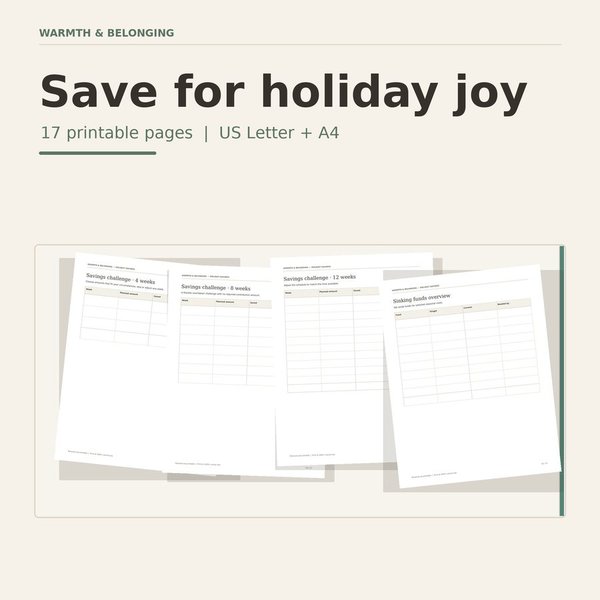
Our Holiday Budget Planner ($5.49) covers this exact method across 17 pages: a holiday savings goal tracker, 4, 8 and 12-week savings challenges, sinking funds for seasonal costs, spending logs, a category budget snapshot, and a payment schedule.
If gifts are the bigger envelope for you, the Christmas Gift Tracker ($6.49) has 19 pages built around it: a holiday budget at a glance, three gift list pages, a gift spending log, a Secret Santa organizer, and a season spending review.
More from us
- Our Etsy shop for more budget and holiday planners
- Browse our printable planners →
- See all 7 holiday printable planners →
We're Warmth & Belonging, an Etsy shop making printable planners and holiday hosting kits. Some of our listings note where AI helped with design; the advice in this post is our own.
Free printable
Get the First-Night Box Checklist, free.
One printable page for move-in day, plus occasional emails about new planners and sales.