



How to Set Up Your 2027 Budget in One Afternoon

You don't need a full weekend to build next year's budget. With your last few pay stubs, a bank statement or two, and about two hours, you can list your income and bills, set a cap for every spending category, put a real plan behind your debt, and pick a savings target you can actually hit. For a printable way to plan this, see our holiday budget tracker printable on Etsy. Here's the order to do it in.
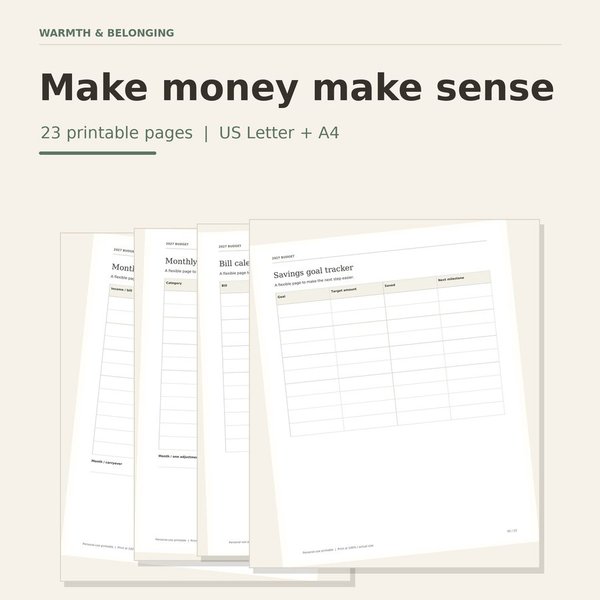
Step 1: List your income and fixed bills
Start with what's certain. Write down your take-home pay for a normal month: your paycheck after taxes, plus any other regular income like a side gig or child support. If your pay changes month to month, use the lowest month from the last few as your starting number, not the best one. It's easier to have extra later than to come up short.
Next, list every fixed bill: rent or mortgage, car payment, insurance, phone, internet, subscriptions, minimum payments on any debt. Planning a move too? Our moving budget guide covers the eight-week schedule. These are the amounts that don't move much from month to month. Add them up and subtract the total from your income. What's left is what you have for everything else: groceries, gas, fun money, savings, and extra debt payments.

Step 2: Pick a monthly cap for each category
Take what's left and split it into categories that match your life: groceries, gas, eating out, personal spending, kids, pets, gifts, whatever actually shows up on your statements. Look at what you spent in each category over the last month or two as a starting point, then adjust up or down based on what you can afford now.
Write a dollar cap next to each category, not just a rough idea. A number you can check against is what makes a budget work. If the totals don't fit inside what's left after bills, cut a category before you start the month, not after you've already overspent it.
Step 3: Plan your debt payoff
If you're carrying any debt beyond a mortgage, list each one: card or loan, balance, interest rate, and minimum payment. Decide how much extra you can put toward debt each month on top of the minimums, using what's left after your category caps.
Then pick an order. Two common ones: pay off the smallest balance first for an early win, or pay off the highest interest rate first to save more money over time. Either works if you stick with it. Put the extra payment toward one debt at a time while paying minimums on the rest, and move to the next one once the first is gone.

Step 4: Set a savings target
Once bills, category caps, and debt payments are covered, decide what's going to savings. If you don't have an emergency fund yet, that comes first, even a small monthly amount toward it counts. After that, split savings across whatever you're working toward: a house, a trip, a car repair fund, retirement.
Give each goal its own number and a rough date. "Save $3,000 for a car repair fund by December" is something you can track. "Save more" isn't. If money is tight this year, a small, honest target you'll actually keep beats a big one you'll abandon by February.
Step 5: A 10 minute weekly check
A budget only holds up if you look at it. Once a week, sit down for about 10 minutes and write down what you've spent in each category so far that month, then subtract it from the cap. This catches a category running over while there's still time to adjust, instead of finding out at the end of the month when it's too late to do anything but feel bad about it.
Keep the debt and savings numbers in the same place as your spending caps, not on a separate sheet you forget to check. Seeing all three together, spending, debt, and savings, is what makes the weekly check worth the 10 minutes.
Keep it all in one place
Our Holiday Budget & Savings Tracker ($5.49) covers a version of this setup across 17 pages: a Christmas savings challenge, sinking funds, a spending log, and a debt payoff tracker, so you can run the holiday months of your 2027 budget in one printable system.
More from us
- Our Etsy shop for more budget and money planners
- Browse our printable planners →
We're Warmth & Belonging, an Etsy shop making printable planners and holiday hosting kits. Some of our listings note where AI helped with design; the advice in this post is our own.
Free printable
Get the First-Night Box Checklist, free.
One printable page for move-in day, plus occasional emails about new planners and sales.